

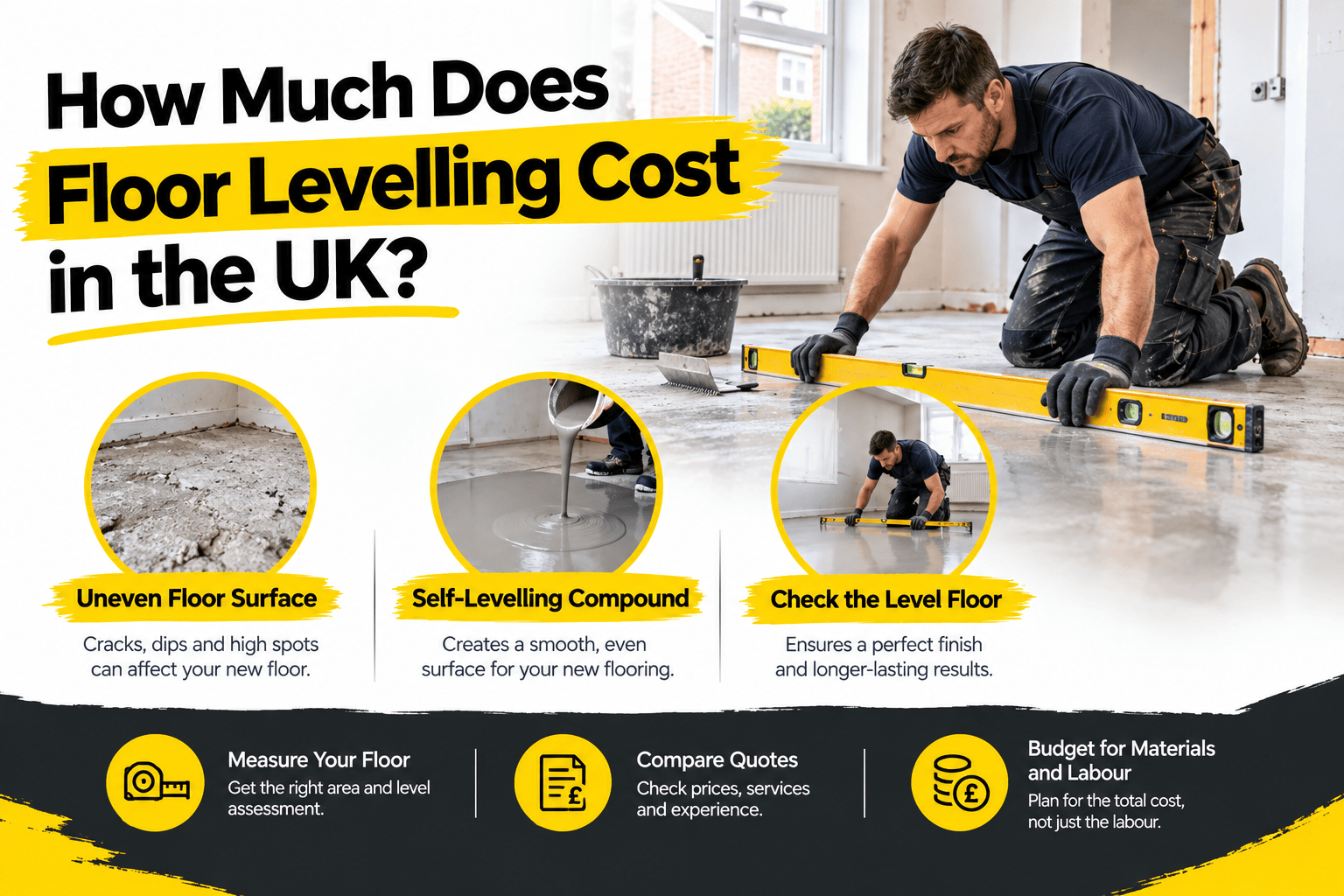
The average cost to have a floor professionally levelled with self-levelling compound is between £8 and £25 per m²
If you are planning to do it yourself, the compound would cost roughly £3 to £5 per m² for a 3mm layer. On the other hand, a full screed costs more, roughly £15 to £35 per m².
Floor levelling cost in the UK depends on three key factors: how uneven the floor is, what the floor is made of, and how much preparation it needs before the real job begins.
The following guide breaks down each cost for a properly designed budget and a guide to reading quotations with confidence.
What are Floor Levelling Costs in the UK
|
Cost type |
Indicative UK price |
What it covers |
| Self-levelling compound (material only) | £13 to £21 per 20kg bag | Product only, roughly 4 to 5 m² at 3mm thick |
| Levelling labour only | £10 to £25 per m² | Application by a floor fitter |
| Self-levelling, supply and fit | £8 to £25 per m² | Compound plus labour |
| Sand and cement screed | £15 to £30 per m² | Thicker, structural-grade layer |
| Liquid screed | £18 to £35 per m² | Poured screed, depth dependent |
| Floor layer day rate | £200 to £350 per day | Labour, varies by region |
Published guides vary, which is why the supply-and-fit range overlaps with labour-only rates. Treat these as a starting point, not a fixed price.
What Is the Average Floor Levelling Price Per Square Metre?
If your room has minor dips and a standard size, expect a supply and fit floor levelling price per square metre in the low to mid teens.
Here is how that translates into real projects:
|
Room |
Area |
Indicative supply-and-fit cost |
| Small bathroom | 5m² | £40 to £125, plus any minimum charge |
| Kitchen | 15m² | £120 to £375 |
| Living room | 20m² | £160 to £500 |
Irrespective of the floor size, setting up and clearing away take roughly the same effort. However, smaller rooms usually cost more per m²
You can hire an experienced tradesperson and consult them for an appropriate budget guide.
What Affects the Cost to Level a Floor?
Several factors push your price up or down:
- Severity of unevenness: If you use a 3mm skim, it will require less compound than a 10mm build up. Doubling the thickness is directly proportional to the material cost.
- Subfloor type. If concrete, it will generally take compound directly once you have primed it. However, timber floors require plywood overboarding first. This adds up to labour and materials.
- Preparation. The efforts pre-flooring matter too. Lifting old flooring, removing adhesive, cleaning and priming can all appear as separate line items.
- Repairs. Cracks, loose boards or damp must be dealt with before levelling.
- Location. A floor layer charging £300 a day in London may charge closer to £180 to £220 in the north of England.
- Access. Upstairs rooms or tight spaces slow down mixing and pouring.
Preparation is where budgets slip. On an old, uneven floor, prep can cost as much as the new flooring itself.
How Much Does Self-Levelling Compound Cost in the UK?
A bag weighing around 20kg of self-levelling compound costs an average of £13 to £21 in UK merchants. The prices can still be different for each brand as well as covered depths.
That puts the self-levelling compound cost at around £3 to £5 per m² for a thin layer. Add primer, a mixing paddle and possibly edging strips.
One important limit: self-levelling compound smooths a stable floor. It does not fix structural movement, bouncy joists or rising damp. If the floor moves, the compound will crack.
How Much Does It Cost to Level a Concrete Floor?
Concrete floor levelling cost usually sits at the lower end of the range, because concrete is a rigid, compatible base. The main extras are:
- Cleaning off dust, paint and old adhesive
- Applying primer so the compound bonds
- Filling cracks before pouring
- Checking moisture, especially on ground-floor slabs
Minor surface dips are routine work. Large cracks, sunken areas or a slab that keeps moving point to a bigger problem that needs assessment before any levelling. Wooden floor tiles are a completely different story.
Floor Levelling vs Screeding: Which Costs More?
Screeding is more expensive than floor levelling. Standard sand and cement screed sits at around £15 to £30 per m²
The two are different jobs. Self-levelling compound is a thin finishing layer, often just a few millimetres, laid over an existing sound floor. Screed is a thicker layer, used to build up floor height, bury underfloor heating or create a new base. Some products bridge the gap: cement-based levelling screeds can be applied from 3 to 50mm in a single application.
If a quotation says “screed” when you expected a thin levelling coat, ask why. It may be justified, but the price difference is significant.
How Can You Save Money on Floor Levelling?
- Get two or three itemised quotes. Compare preparation, priming and materials line by line.
- Book levelling with your flooring. One visit avoids paying for two call-outs.
- Clear the room yourself. Removing furniture saves paid labour time.
- Only level what needs it. A fitter may treat a single low area rather than the whole room.
- Do not skip primer or repairs. Cutting these corners usually costs more later.
If you are fitting new laminate, it also helps to know how long laminate flooring takes to fit, so you can plan drying time around the installation.
When Should You Hire a Professional Floor Levelling Contractor?
Bring in a professional when:
- The floor dips by more than about 10mm
- You have a timber or suspended floor
- There are visible cracks, damp or movement
- You are laying tiles, LVT or engineered wood that need a very flat base
- The area is larger than one small room
Experienced floor fitters can prepare and level your subfloor as part of the installation, so the new floor sits flat and lasts.
Conclusion
Floor levelling cost in the UK usually ranges from a few pounds per m² for DIY compound to £25 per m² or more for professional work, with screeding costing more again. However, the real cost driver is the condition of your floor.
If your floor requires a hefty job to get rid of the old one, it will ultiamtely cost more. It is crucial to understand that first to make the quotation easier to judge.
Ready to get your floor sorted? Explore professional floor fitting services or find a local tradesperson through The Trade Core directory and compare quotes for your project.
Frequently Asked Questions
How much does it cost to level a small room in the UK?
A 5 to 10m² room typically costs £40 to £250 supplied and fitted, though minimum charges can raise this.
How much self-levelling compound do I need?
Most 20kg bags cover about 4 to 5m² at 3mm. Measure the deepest dip, then check the coverage chart on the bag.
Can you level an uneven floor without replacing it?
Usually, yes, if the existing floor is stable. Self-levelling compound or overboarding can correct minor unevenness.
How long does floor levelling take?
Application often takes a few hours. Drying varies by product, with some ready for tiles within hours and vinyl after 24 hours or more.
Do floor fitters level floors before installing new flooring?
Many do, but it is often priced separately. Check whether levelling is included in your quotation.